ten·ten·toon /ˌtɛn.tɛnˈtoːn/ noun
1. a self-repeating image whose copies spiral as they shrink, in the manner of M. C. Escher's Print Gallery.
• a tententoon of the old gallery, winding inward without end.
Origin coined from the Dutch Prentententoonstelling (“print exhibition”): prenten, prints + tentoonstelling, exhibition — the word lifted from where the two halves meet.
First, the easy version
Put a picture inside itself. Then put it inside that copy, and inside the next, and don't stop.
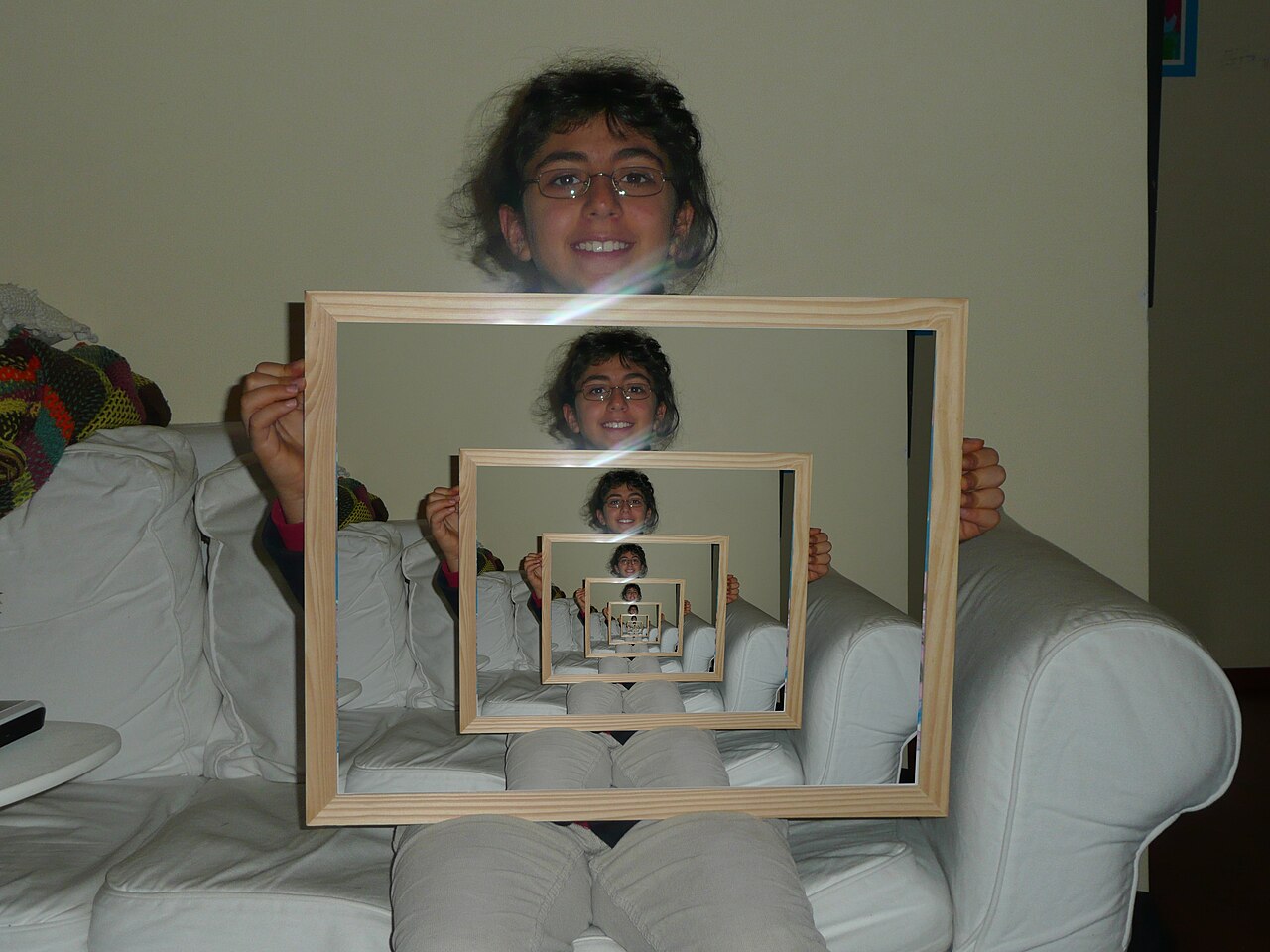
Every copy sits squarely inside the one before it. The picture drops straight down into itself, shrinking by the same step each time, forever. That is the Droste effect, and you have seen it a hundred times.
Now bend it
Here is a stranger question. What if each copy does not only shrink — what if it also turns?
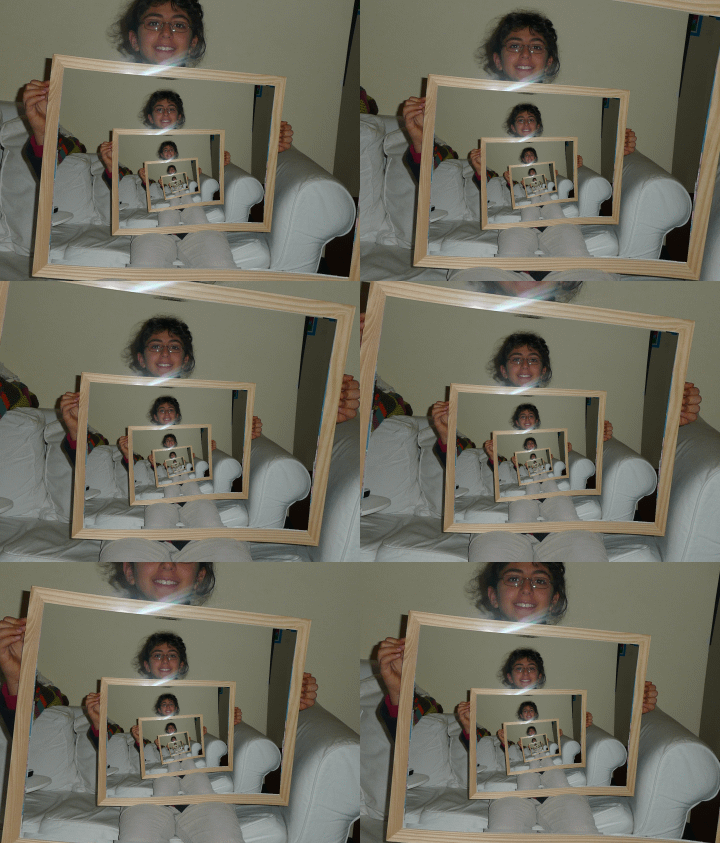
Same picture. Same rule — a copy, inside a copy, inside a copy. But now every copy is rotated a little as it shrinks, and the whole stack winds up into a spiral. Watch the edges: straight lines bow into curves, the room twists — and nothing tears. Follow any line inward and it meets itself exactly. Zoom forever and you never find a seam.
That second picture is a tententoon.
Same picture. Two infinities. One drops straight down; the other takes the scenic route — and still arrives on time.
Why doesn't it tear?
All of it comes from one move: take the logarithm.
Shrinking-and-repeating is really multiplication — each copy is the last one times some fixed ratio. And the one thing logarithms do for a living is turn multiplication into addition. So look at the Droste picture through a logarithm and “shrink, then repeat” becomes “slide over, then repeat”: the endless nested frames unroll into a plain, evenly-spaced grid. Straight. Boring. Repeating.
Now add the turn. A copy that shrinks and rotates is, in this logarithm-world, a slide in two directions at once — sideways and along. So the straight grid simply tilts. Tilt a repeating grid, then roll it back up out of the logarithm, and that tilt becomes a spiral. A tententoon is just Escher's straight Droste, leaning over.
And here is why it never tears. In logarithm-world the picture is only a pattern that repeats every fixed step. Slide it by exactly one step and you land on an identical picture — you cannot tell it moved. Roll that back up, and “one step” becomes “one full turn of the spiral.” The loop closes because the shift closes. The seam isn't hidden; there simply isn't one.
The same trick, in four pictures
Here is the whole move, broken into the four frames the mathematics actually passes through.
- The picture, and a rectangle. Mark where the next copy belongs. That single choice fixes everything else: how far each copy shrinks (call it S), and the one point c that all the copies rush toward.
- Unroll it — log(z − c). Re-measure every point by how far it sits from c and at what angle, then take the logarithm of the distance. The endless nested frames flatten into a plain, repeating lattice: step sideways by log S and you have moved one Droste jump; step up or down by 2π and you have gone once around c. Straight. Boring. Tiling forever.
- Lean it over. Tilt that lattice by a fixed angle, β = arctan(log S / 2π). Nothing tears: a pattern that repeats every tile looks identical after you slide it by one tile, so it survives the lean unscarred. That lean is the whole difference between a Droste and an Escher.
- Roll it back up. Undo the logarithm and the tilted lattice winds into the tententoon — one seamless spiral. In a single line it is the map w(z) = c + (z − c)α with α = 1 − i·(log S / 2π): the real part carries the picture, the imaginary part is the lean.
The same photograph sits in all four frames; only the ruler changes. The seam never shows because in the two flat middle frames there is nothing to tear — only a pattern, repeating.
Escher got there first — by hand
Escher had no computer in 1956. He worked the curved grid out by eye, ruled it onto the canvas, and painted a gallery, a print, a town, and the gallery again into the bend. And he got it right — the mathematics later showed his intuition was very nearly exact.
But a spiral tightens forever toward its centre, and a pen can only go so fine. So Escher stopped, left a soft white patch in the middle of the picture, curled his signature into it, and called it finished. The one place the picture could not finish itself.
The theorem that filled the hole
In 2003, two mathematicians in Leiden — Bart de Smit and Hendrik Lenstra — wrote down the exact map hiding in Escher's grid. The idealised Print Gallery, they showed, contains a complete copy of itself rotated by 157.6256° and shrunk by a factor of 22.5837. Pin those two numbers down and the entire picture is determined — including the part Escher left blank.
With the map in hand, they let a computer do what a pen could not: continue the spiral inward, far past the reach of any hand, and close the white hole at last.
See it move
If you'd like the whole argument in motion, Grant Sanderson (of 3Blue1Brown) made a beautiful animated tour of the paper in 2026. It is the clearest walk through the mathematics there is — watch it here.
Now make one
This tool does the bending for you. Drop in any photo, draw the rectangle where the next copy should sit, and flip between the two infinities: the straight Droste fall, or the tententoon spiral. Export the loop as a PNG, a GIF, or a video. It all runs in your browser — no upload, no account, no server.